Chinese
 English
 Deutsch
 italiano
 español
 português
 Nederlands
 日本語
日本語 한국의
한국의




- Guide de configuration d'un laboratoire de batteries à semi-conducteurs clés en main
- Matériaux conducteurs pour batteries au lithium : guide comparatif CNT vs graphène
- Guide étape par étape pour s'associer avec un développeur de technologie de batteries sodium-ion en Chine
- Un guide complet pour la mise en œuvre de la technologie des batteries à semi-conducteurs industrielles dans la fabrication
- Comment sélectionner un fournisseur professionnel d'équipements de batterie pour une production à haut volume
China Power Battery Market Report 2026 H1: Six Trends Reshaping Battery Equipment Demand
By Dany Huang, Ph.D. · XIAMEN TOB NEW ENERGY TECHNOLOGY Co., Ltd.
This market review is based on the China Power Battery Market Research Report, 2026 H1, and has been expanded with the equipment and process implications for manufacturers, research institutions and production-line investors. Equipment references link to the corresponding product pages on this site.
Executive Summary
In the first half of 2026 - the opening year of China's 15th Five-Year Plan - the Chinese power battery industry continued to grow at high quality. Installations reached 335.6 GWh (+12.0%), while combined power and energy-storage battery sales reached 661.3 GWh (+36.2%). Lithium iron phosphate (LFP) consolidated its position with an 81.0% share of installations. The market is shaped by a "CATL plus BYD duopoly with a tightly contested second tier": top-10 concentration stands at 93.9%, yet positions within the second tier change frequently. Profitability is sharply divergent - leading cell makers post gross and net margins far above those of vehicle manufacturers, while some third-tier producers grow revenue without growing profit, or remain loss-making.
| Indicator | Value | Comment |
| Domestic installations, 2026 H1 | 335.6 GWh | +12.0% year on year |
| LFP share of installations | 81.0% | Dominant chemistry reinforced |
| Top-10 concentration | 93.9% | Duopoly plus a contested second tier |
| CATL share of installations | 46.0% | +2.99 percentage points |
| CATL net profit attributable to shareholders, H1 | RMB 43.284 billion | +42.0% |
| Battery share of vehicle BOM | 35–40% | Largest single cost item |
| Aviation battery pack market CAGR | 41.8% | Low-altitude economy as a new engine |
| Humanoid robot shipment growth, 2026 | +700% | Global volume above 51,000 units |
Scope: China domestic power battery installations, January–June 2026, sourced from China Automotive Battery Innovation Alliance data as reported on 16 July 2026. The full-year figure is an institutional forecast, not realised data. Net profit and market-share figures are company disclosures at group scope where stated.
Six findings in brief
- Market: steady growth, a frozen structure. Installation growth has slowed to a low double-digit rate; the industry has moved from high-speed expansion to structural upgrading. LFP penetration passed 80%, while ternary chemistries retreat to high-end and export models.
- Companies: winner takes most. CATL earned RMB 43.284 billion net in H1 on R&D spending of RMB 11.377 billion; BYD's R&D spending of RMB 28.9 billion ranked first across the A-share market. Second-tier margins are generally in the single digits, and some third-tier producers remain loss-making.
- Applications: the second growth curve has started. The low-altitude economy (eVTOL) and humanoid robots have become proving grounds for high-energy-density batteries, where solid-state and semi-solid-state chemistries are reaching scale first.
- Technology: multiple routes in parallel. Fifth-generation LFP plus LMFP, mass-produced sodium-ion cells, and semi-solid and all-solid-state cells moving into pilot and demonstration - the industry is no longer betting on a single chemistry.
- Recycling: a compliance rebuild. In July 2026 the Ministry of Industry and Information Technology retired the echelon-use provisions, folding retired batteries into a unified "comprehensive utilisation" system, and raised recovery thresholds to at least 98% for nickel, cobalt and manganese and 90% for lithium.
- Planning: from scale to value. The 15th Five-Year Plan targets high-end, intelligent, green and international development, prioritising all-solid-state, sodium-ion and lithium-metal technologies while extending into low-altitude, robotics and other new applications.
Core judgement. China's power battery industry has moved from leading on scale to competing on value. In the short term, capacity clearing and price competition remain the dominant themes. In the medium term, high-performance batteries (solid-state, sodium-ion, fast-charging, LMFP) and new application scenarios (low-altitude, embodied intelligence) will define the next growth curve. Recycling capability and carbon footprint are becoming the entry ticket to global competition.
01 Industry Overview and Market Structure
Scope: "power battery" in this report refers to lithium-ion traction batteries for new energy vehicles (LFP and ternary), extended in the emerging-application section to high-energy-density cells for eVTOL and humanoid robots. Statistics follow the China Automotive Battery Innovation Alliance unless stated otherwise.
1.1 Overall scale: growth changes gear into a low double-digit range
In the first half of 2026, China's cumulative power battery installations reached 335.6 GWh, up 12.0% year on year. Combined power and energy-storage battery sales reached 661.3 GWh (+36.2%), and cumulative sales for January to July rose to 790.4 GWh (+37.1%). Over a longer horizon, installations grew from 63.6 GWh in 2020 to 769.7 GWh in 2025 - more than a tenfold increase in five years. The industry has shifted from high-speed growth to structural growth; institutions forecast full-year 2026 domestic installations of approximately 888.7 GWh (+10.8%).
For equipment planners, the practical reading of this shift is that capacity is no longer the constraint. Growth now comes from chemistry transitions, yield improvement and cost per GWh - the parameters set by the electrode preparation and cell assembly train, from coating through to formation. It is the perspective TOB NEW ENERGY works from when specifying lines for customers: throughput is now the easy part, and flexibility is the hard part.
1.2 Chemistry: the "80% era" of lithium iron phosphate
LFP installations reached 272.0 GWh in 2026 H1, an 81.0% share (+11.5%), while ternary chemistries accounted for 63.4 GWh (18.9%, +14.2%). LFP's advantages are concrete: thermal runaway temperature above 500°C, cycle life of 3,000 to 10,000 cycles, and material cost roughly 30% below ternary. As a result LFP now penetrates all three major markets - stationary storage, commercial vehicles and mass-market passenger cars - while ternary retreats to models above RMB 250,000 and to export applications. Institutions expect fifth-generation LFP (including LMFP) to exceed a 30% market share in 2026.
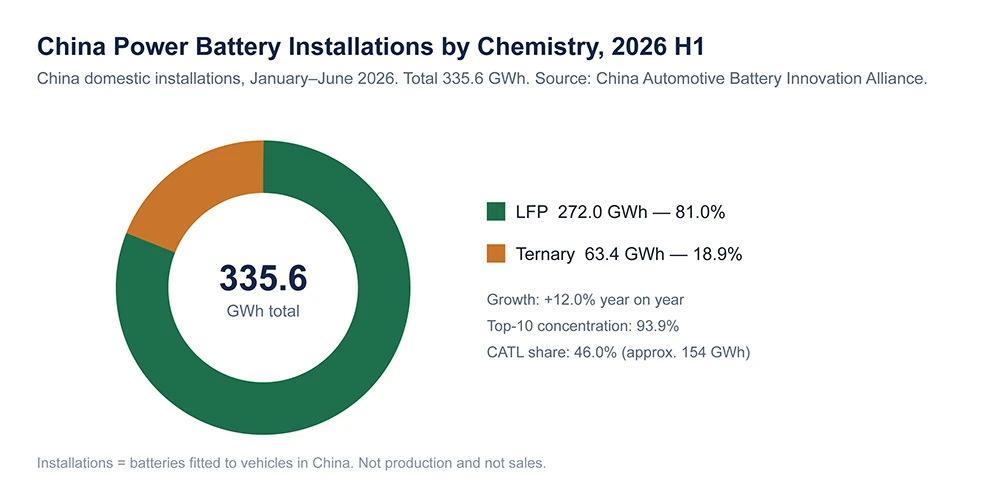
Figure 1. China power battery installations by chemistry, 2026 H1. Source: China Automotive Battery Innovation Alliance.
The logic behind the structure. In the first quarter of 2026, energy-storage battery shipments reached 209 GWh (+115% year on year), of which LFP accounted for more than 97%. Stationary storage therefore amplifies LFP demand further, upgrading it from "a passenger-car choice" to the base chemistry of both traction and storage.
This has a direct supply implication for R&D and pilot lines: a single laboratory or pilot train increasingly has to handle LFP, LMFP and sodium-ion cathode powders, plus different anode materials. Cathode and anode powder handling, cathode active materials such as LFP, NMC, NCA and LNMO, plus LMFP grades such as lithium manganese iron phosphate cathode powder. Equipment is therefore specified as multi-chemistry from the outset rather than as a single-recipe installation. That is a requirement TOB NEW ENERGY builds into pilot and production configurations.
1.3 Competitive landscape: a stable duopoly and a crowded second tier
2026 H1 installation concentration reached CR3 = 69.4%, CR5 = 80.6% and CR10 = 93.9%, holding at a high level. CATL led with 154.25 GWh (46.04%), up 2.99 percentage points year on year. BYD with 57.42 GWh (17.14%); on a passenger-vehicle-only basis BYD's share was 46.7%. Gotion, CALB and EVE ranked third to fifth with gaps of less than 0.2 percentage points between them. LG Energy Solution was the only overseas brand in the top ten.
Note on methodology: under the Gasgoo Research passenger-vehicle-only basis, CATL accounted for 100.7 GWh (42.7%) and FinDreams Battery 53.8 GWh (22.8%), a combined 65.5%, while the all-vehicle basis puts CATL at 46.04%. This report follows the all-vehicle basis of the China Automotive Battery Innovation Alliance and labels each basis on use.
02 Leading Manufacturers: Scale, Revenue, Net Profit and R&D Investment
Data period: first half of 2026, in RMB. BYD is reported at group level (including vehicles and electronics); other companies are presented mainly on their battery business. R&D disclosure is complete only for CATL and BYD; other manufacturers do not disclose R&D for the battery segment separately.
2.1 Revenue and net profit: the leaders dominate, the tiers are distinct
Figures are drawn from each company's 2026 half-year report and announcements. CATL's half-year disclosure remains the reference point for the sector, because its scale sets the industry cost curve.
| Company | Revenue (RMB bn) | YoY | Net profit (RMB bn) | YoY | H1 installations (GWh) | Tier |
| CATL | 276.917 | +54.8% | 43.284 | +42.0% | 154.25 | First tier |
| BYD (group) | 344.815 | - | 12.325 | - | 57.42 | First tier (captive) |
| EVE Energy | 45.691 | +62.2% | 3.301 | +105.7% | 16.80 | Second tier |
| Gotion High-tech | 27.776 | - | 1.386 | High growth | 20.75 | Second tier |
| CALB | 27.084 | +65.0% | 1.523 | +102.2% | 20.71 | Second tier |
| Rept Battero | 14.916 | +57.2% | 0.778 | Turned profitable | 11.11 | Third tier |
| Sunwoda | 38.179 | +41.5% | 0.603 | −29.6% | 9.15 | Third tier |
| Zenergy | 5.438 | +71.4% | 0.372 | +68.6% | 9.06 | Third tier |
| Farasis Energy | 3.616 | −16.9% | −0.397 | Loss widened | - | Third tier (under pressure) |
Scope: company-reported figures for 2026 H1 (January–June), RMB. BYD and Sunwoda are reported at group scope, which includes vehicles, electronics and other businesses; battery-segment figures are not separately comparable. Installation volumes are China domestic, from alliance data. R&D is disclosed for CATL and BYD only.
Gotion's second-quarter net profit attributable to shareholders grew 413% year on year on a low base; H1 net profit attributable to shareholders was approximately RMB 1.386 billion. Sources: 2026 half-year reports, the China Automotive Battery Innovation Alliance, financial data providers and business media.
2.2 R&D investment: the ammunition depot of hard-technology competition
R&D intensity is the key to surviving the cycle. CATL invested RMB 11.377 billion in R&D in 2026 H1 (+12.7%) and held 60,319 patents globally at the end of the period. BYD invested RMB 28.9 billion (RMB 23.307 billion expensed plus RMB 5.593 billion capitalised), an R&D intensity of about 8.4%, the highest among A-share listed companies and 2.35 times its net profit attributable to shareholders over the same period, with cumulative R&D investment above RMB 270 billion. Among second-tier manufacturers, several have entered the group of ChiNext companies investing more than RMB 1 billion in R&D, although battery-segment R&D is not disclosed separately.
Differences in earnings quality. CATL's 2026 H1 gross margin was 23.93% and net margin 16.98%. Within its segments, power battery systems earned 20.63% gross margin and energy storage 23.96%, while battery materials and recycling reached 27.04%. Mainstream vehicle manufacturers, by contrast, report net margins of only 1.5% to 4.5% - cell suppliers earn roughly four times the net margin of their customers, and profit is clearly concentrating upstream.
That margin gap is funded by R&D throughput, which in turn depends on measurement capability: the number of cells that can be characterised accurately per unit of researcher time. Beyond chemistry, R&D productivity is increasingly a function of workstations - multi-channel potentiostats and electrochemical test benches such as a single-channel electrochemical workstation allow new material systems to be screened before they are committed to a pilot line.
03 The Battery's Share of the Vehicle Bill of Materials
Basis: manufacturing cost structure of new energy passenger vehicles, from industry cost studies, including differences across vehicle classes and price bands.
The battery is the single largest cost item in a new energy vehicle. Industry studies generally put it at 30% to 45% of the vehicle bill of materials, with a mainstream range of 35% to 40%; in A00 and A0 class low-end models it can reach 45%. Together with the motor and electronic control unit, the "three electrics" account for 47% to 55% of vehicle cost. Within the rest of the bill of materials, the motor and electronic control represent 12% to 15%, the chassis 14% to 16%, automotive electronics and intelligent systems 8% to 10%, and other components roughly 15% to 20%.
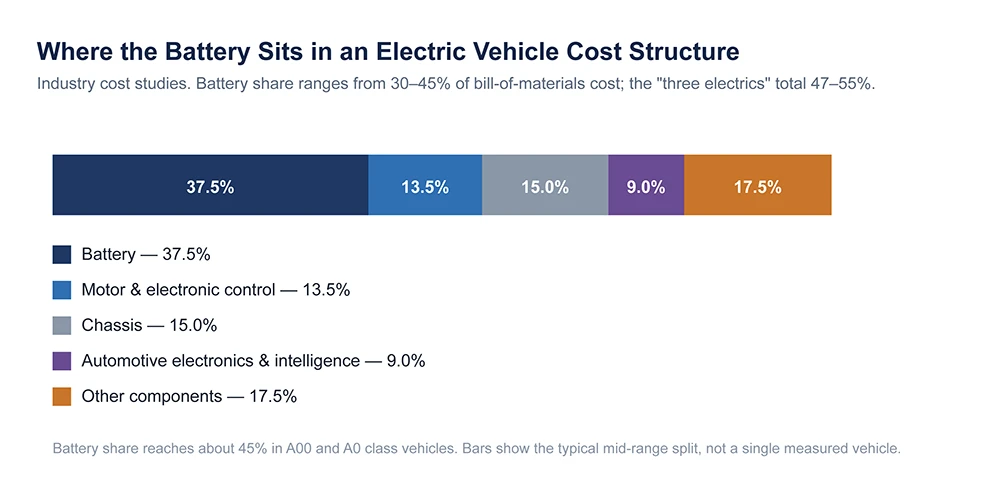
Figure 3. Battery share of an electric vehicle cost structure. Industry cost studies; the bar shows a typical mid-range split.
The cost transmission chain. With the battery at 30% to 40% of bill-of-materials cost, every one percentage point of cell cost reduction releases roughly 0.3 to 0.4 percentage points of vehicle pricing room. In 2025 CATL's capacity utilisation reached 96.9% against an industry average below 60%; scale spreads fixed costs, which is the basis for its high gross margin and, in turn, its influence over global vehicle pricing. Vehicle manufacturers are caught between rising revenue and falling profit, while cell makers earn roughly four times their customers' net margin.
The equipment consequence is that cost per GWh - not throughput alone - becomes the specification criterion. Two levers dominate. The first is solvent-free processing: a dry electrode preparation solution removes solvent handling and the long drying ovens that consume both floor space and energy. The second is the electrode train itself: higher calendering pressure and uniform temperature control in a hydraulic heating calendering machine raise electrode density and reduce scrap, which is where the largest per-unit savings usually sit. In practice the two levers are combined: a dry electrode film forming machine validates the solvent-free route at pilot scale before a factory commits to a full dry line, which is how TOB NEW ENERGY scopes dry-electrode projects for customers still comparing routes.
04 Emerging Applications: the Low-Altitude Economy and Humanoid Robots
Measurement basis: eVTOL and aviation battery pack market data from third-party institutions, and humanoid robot battery data from TrendForce and GGII. The field is in early commercialisation and forecasts diverge. Figures are therefore presented as ranges, and multiple sources are shown in parallel.
4.1 The low-altitude economy (eVTOL): the first landing point for high-energy-density batteries
eVTOL aircraft are predominantly pure-electric, which imposes requirements far beyond automotive: an aviation-grade cell energy density target above 400 Wh/kg (automotive cells are around 250 to 300 Wh/kg), instantaneous discharge of 4.8C to 10C, and airworthiness-level safety - no fire under nail penetration or extrusion. 2026 is regarded as the year of concentrated type-certificate approval for crewed eVTOL, with several models from EHang, Vertaxi, Aerofugia and XPeng AeroHT in the final stage of certification review.
| Indicator | Value | Source basis |
| Global high-energy-density aviation battery pack market, 2025 | USD 1.86 billion | Institution estimate |
| Same market, 2030 estimate | USD 14.25 billion (CAGR 41.8%) | IIM industry report |
| Global aviation battery demand, 2025 | 2.9 GWh (eVTOL 71.2%) | Institution estimate |
| Low-altitude solid-state battery incremental market, 2026 | ≈RMB 9.5 billion (first-fit ≈RMB 6.2 bn, replacement ≈RMB 1.0 bn, logistics drones ≈RMB 2.3 bn) | Securities research |
| Battery system share of eVTOL cost | 30–40%, replaced every 1–2 years | Industry estimate |
Scope: third-party institution estimates and securities research, not audited statistics. The 2026 low-altitude solid-state battery figure is a securities-house projection; market-size figures are modelled ranges that diverge between sources. Battery cost share and replacement interval are industry estimates.
Because the pack is a consumable replaced every one to two years, the sector generates both a first-fit and an aftermarket curve. In 2026 H1 announced domestic solid-state capacity expansion exceeded RMB 50 billion, of which aviation cell planned capacity alone exceeded 30 GWh.
Aviation cell supply landscape (2026 positioning).
- CATL - sulfide condensed-matter system at 500 Wh/kg, with Vertaxi.
- Sunwoda - semi-solid at 380 Wh/kg supplying EHang and XPeng AeroHT, Shenzhen 3 GWh line at full capacity.
- Ganfeng Lithium - oxide system at 320 Wh/kg for Aerofugia.
- Xinjie Energy - lithium-metal all-solid-state at 500 Wh/kg, 10 GWh base under construction.
- Gotion and Farasis - semi-solid at 330 to 350 Wh/kg for GAC's low-altitude division and others.
Aviation cells push the process chain into territory that conventional lithium-ion tooling does not cover: lithium-metal anodes require dedicated handling, and foil thickness tolerances tighten sharply. Equipment such as a lithium-metal anode electrode making machine for solid-state batteries and battery-grade lithium metal foil strip material becomes the constraint on whether a design can be sampled at all - the aviation specification pushes cells beyond what automotive tooling was designed for.
4.2 Humanoid robots: the ideal testbed for solid-state batteries
Global humanoid robot shipments are expected to exceed 51,000 units in 2026, a 700% year-on-year increase, with Chinese production up 94%; Unitree and AgiBot together account for close to 80%. Their power batteries must deliver walking, grasping, joint actuation and compute power within a limited torso volume, imposing a "four highs" requirement - high energy density, high rate capability, high safety and long cycle life - that is in some respects stricter than automotive.
Battery demand from the sector is small today - approximately 0.05 GWh in 2025 - but TrendForce and GGII project it reaching roughly 74 GWh by 2035. The immediate equipment need is not volume but flexible, small-batch validation: research cells such as an anode-free pouch cell and anode-side components such as lithium metal copper current collector anode foils allow high-energy-density architectures to be prototyped and cycled before any pilot line is committed. For robot battery teams the practical starting point is usually a small glovebox-based line rather than a conversion of an existing lithium-ion line, an approach TOB NEW ENERGY applies to high-mix research programmes.
05 Technology Trends and Manufacturers' R&D Routes
The industry consensus is a shift from "one winning chemistry takes all" to "multiple technology routes in parallel", matched to application scenarios by layer.
Terms used in this section. LMFP is lithium manganese iron phosphate: an LFP variant with manganese added, raising energy density by roughly 15% to 20%. Layered oxide is the dominant sodium-ion cathode family; hard carbon is the standard sodium-ion anode material. Semi-solid-state describes a cell using a gel or partially solid electrolyte, already in commercial vehicles. All-solid-state describes a cell in which the electrolyte is solid throughout, still in pilot. Dry electrode means electrode manufacturing without solvent, which removes the drying ovens.
5.1 Energy density comparison: the transition from liquid to all-solid-state
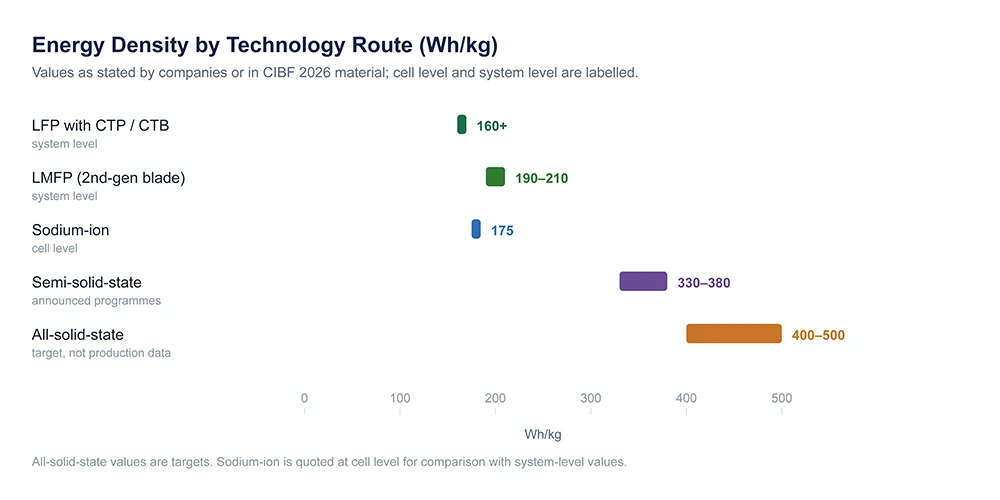
Figure 2. Energy density by technology route (Wh/kg). All-solid-state values are targets, not verified production data.
| Route | Energy density (as stated) | Sourcing |
| LFP with CTP / CTB structural integration | System level stable above 160 Wh/kg | Industry technology review |
| LMFP (second-generation blade architecture) | System level 190–210 Wh/kg | Company disclosure |
| Sodium-ion | Cell level 175 Wh/kg | Company disclosure |
| Semi-solid-state | 330–380 Wh/kg in announced production programmes | Company disclosure |
| All-solid-state | Target 400–500 Wh/kg | Company disclosure / CIBF 2026 |
Scope: figures are as stated by the companies concerned or in CIBF 2026 material, and mix cell-level and system-level measurements; the level is stated in each row. All-solid-state values are targets, not verified production data.
5.2 Six technology mainlines
① Fifth-generation LFP and LMFP. The LFP base continues to be upgraded. BYD's second-generation blade battery uses an LMFP composite cathode with a silicon-carbon anode to reach a system energy density of 190 to 210 Wh/kg and CLTC range above 1,000 km; adding manganese raises energy density by 15% to 20%. Global LMFP output reached 28,500 tonnes in 2025, up 206.5%. For materials and pilot work, this means both the compound cathode powder route - for which LMFP cathode materials are the starting point - and the anode-side consequences of silicon-carbon (higher calendering pressure, greater swelling) have to be designed in together.
② Sodium-ion batteries. CATL's sodium-ion cell delivers 175 Wh/kg on a third-generation CTP platform with range above 400 km. It retains more than 90% capacity at −40°C and still discharges at −50°C. Changan's sodium-ion mass-production passenger car, a world first, launches in mid-2026. Cost parity with LFP is expected by the end of 2026, with shipments forecast above 20 GWh in 2026 and above 500 GWh by 2030.
Sodium-ion shifts the material bill of materials rather than the assembly process: layered oxide cathodes, hard-carbon anodes, and dedicated formation and grading protocols. Equipment to look at spans layered oxide cathode materials for sodium-ion batteries, hard carbon anode materials and a 512-channel sodium-ion formation and grading tester. The underlying chemistry of sodium-ion batteries is well documented for teams new to the system. TOB NEW ENERGY supplies sodium-ion equipment both as standalone laboratory sets and as convertible configurations on lithium-ion lines.
③ Semi-solid and all-solid-state. Semi-solid cells are already commercial: WeLion's 150 kWh pack for NIO delivers more than 1,000 km. All-solid-state targets 400 to 500 Wh/kg. CATL plans small-batch production in 2027; Gotion's "Gemstone" 2 GWh line is scheduled for the end of 2026; GAC plans small-batch output in 2026 and wider rollout from 2027 to 2030; SAIC's "Guangqi" programme is due in 2027.
The bottlenecks are interfacial and environmental rather than conceptual. Solid–solid contact must be maintained across the whole electrode area, and sulfide electrolytes demand dew points in the −50°C to −65°C range or inert handling. This is where the equipment chain changes most. LATP solid electrolyte powder requires controlled atmospheres. A solid electrolyte transfer lamination machine addresses membrane transfer without pinholes, and a warm isostatic press consolidates the stack evenly, which flat uniaxial pressing cannot do without edge cracking.
These are an environment problem before they are a coating problem: the solid-state battery literature is clear on the mechanism, but the equipment specification decides whether a process can be repeated.
④ Ultra-fast charging and large cylindrical cells. Hongqi, working with a cell partner, demonstrated 12C charging from 10% to 70% in 3 minutes 41 seconds; Gotion's second-generation G-series supports 12C; EVE's 46-series large cylindrical cells supply BMW's New Class models. The 800V ultra-fast charging architecture has moved from concept to a defined production timeline. High-rate capability is decided upstream: a needle-bed cylindrical cell formation and grading system with energy feedback determines whether capacity spread stays tight enough for 12C operation, where small deviations are amplified. Cell format follows the same logic: tabless large cylindrical designs need consistent jelly-roll flattening, which is why a flattening machine for 4680 and 32140 tabless cells is specified alongside the formation equipment rather than after it.
⑤ Structural innovation. CTP, CTB and Kirin-class pack architectures continue to close the system-level energy-density gap between LFP and ternary, holding system density above 160 Wh/kg. On the manufacturing side, tabless cylindrical designs are becoming mainstream precisely because they reduce internal resistance for fast charging and simplify current-collector welding - a direction that reshapes the assembly and welding stations rather than the chemistry.
⑥ Divergence in R&D routes. Leaders pursue full-stack development with AI integrated into research and manufacturing; the second tier differentiates (commercial vehicles and storage, large cylindrical cells, solid-state plus overseas expansion); the third tier seeks breakout positions in aviation semi-solid and storage. Screening capability underpins all three: the ability to characterise many cells in parallel, for example through multi-channel potentiostat, galvanostat and EIS systems, determines how quickly a route decision can be made or abandoned.
Route judgement. Over the next three to five years, the likely division of labour is clear. LFP and LMFP hold the base, sodium-ion covers low temperature and entry segments, semi-solid moves up-market, and all-solid-state sets the benchmark. This is not a substitution sequence. It is a technology selection driven by vehicle price band and application scenario.
06 Battery Recycling: Technology and Environmental Impact
2026 is the inflection year in which recycling moves from unregulated growth to technology-driven, compliance-based operation.
6.1 Policy rebuild: echelon use exits, comprehensive utilisation unifies
- On 30 July 2026 the Ministry of Industry and Information Technology repealed the echelon-use provisions. Echelon-use company listing was discontinued, approximately 100 previously listed echelon-use companies were removed, and retired batteries were brought into a unified "comprehensive utilisation" system. The notice also requires that retired batteries not be used as complete packs, or as packs reassembled from disassembled cells, in applications such as electric bicycles, and instructs standards organisations to review and repeal or revise the related echelon-use standards.
- "Digital identity" traceability throughout the life cycle. Every battery carries a unique code scanned through production, sale, repair and scrapping, and "vehicle and battery scrapped together" requires the battery to be handed over with the vehicle, closing the leakage gap.
- Recovery thresholds (corrected attribution). The recovery indicators of not less than 90% for lithium and 98% for nickel, cobalt and manganese come from the 2024 edition of the Industry Standard Conditions for the Comprehensive Utilisation of Retired New Energy Vehicle Power Batteries, which also sets copper, aluminium and post-separation electrode powder recovery at not less than 98%. They are not set by the 30 July 2026 notice. An earlier version of this article attributed them to the July policy change; the figures are retained because the originating standard has been identified, and the attribution is corrected here.
- More than one million tonnes of retired batteries are expected in 2026, with comprehensive utilisation targeted to exceed one million tonnes annually by 2030.
6.2 Technology: from pyrometallurgy and hydrometallurgy to direct regeneration
Hydrometallurgy (mainstream). Leading operators have raised combined nickel, cobalt and manganese recovery to 99.6% and lithium recovery to 96.5%, achieving a "battery to battery" loop, with process energy consumption roughly 40% below overseas benchmarks and wastewater recycling above 95%.
Direct regeneration (DRT). Ganfeng Lithium's in-house directed recycling and targeted lithium replenishment achieves lithium recovery above 85% through a shorter flow with lower energy consumption, without returning to metal salts for re-synthesis. Internationally, Cornell University's direct electrode regeneration (DEER) research published in Energy & Environmental Science (June 2026) reports 95% capacity recovery and a 56% cost reduction.
Non-destructive echelon use and intelligent screening. Inner Mongolia has built the world's largest retired bus battery energy-storage station, with more than 6,000 packs recombined and grid-connected and AI-based health screening reported at 95%. As of 2026 H1, the Ministry of Industry and Information Technology has published 68 compliant recyclers, with more than 2,000 standardised collection points nationwide; China holds more than 60% of global retired battery processing capacity. Brunp (CATL) can regenerate precursors directly from production scrap, and GEM has built a full "collection, dismantling, regeneration" closed loop with 2026 recycling capacity planned at 300,000 tonnes, expanding into Europe and the Middle East.
Requirements landing on the production line. Higher recovery thresholds and digital identity shift responsibility upstream. Cell-level identification, capacity test records and process parameters now have to be captured and retained at formation and grading, which is why an energy feedback formation and grading system is increasingly specified for its data output as much as for its energy saving. Retired cells entering second-life screening also need abuse-level safety verification, performed with equipment such as a battery heavy impact, needling and crushing testing machine.
07 Next-Phase Development Plans and Targets
Based on the Ministry of Industry and Information Technology's 15th Five-Year Plan for green and low-carbon industrial development, the lithium battery industry 15th Five-Year Plan research report, and official statements at the 2026 World Power Battery Conference (3 September).
7.1 Four core tasks of the 15th Five-Year Plan
- Build a complete modern industrial system. Consolidate the full chain from mining through materials, cells, systems, equipment and recycling, and strengthen global competitiveness.
- Achieve high-level technological innovation. Focus on breakthroughs in all-solid-state, sodium-ion and lithium-metal batteries, with new material systems and process architectures raising energy density, safety and durability together. In equipment terms this is already visible in demand for solid-state R&D tooling such as a slot-die coating machine for solid-state R&D in glovebox operation, a configuration normally supplied as part of an integrated solid-state equipment package.
- Build a cross-industry integration ecosystem. Extend into low-altitude equipment, intelligent robots, electric ships, electric construction machinery and new energy agricultural machinery.
- Advance high-level internationalisation. Encourage leading companies to expand overseas, build a new global pattern, and align standards systems internationally.
7.2 Key quantified targets and milestones
| Direction | Target / milestone | Source |
| All-solid-state batteries | CATL small batch 2027; Gotion 2 GWh line end-2026; GAC small batch 2026, rollout 2027–2030; SAIC "Guangqi" 2027 | Company disclosure / CIBF 2026 |
| Sodium-ion batteries | Cost parity with LFP by end-2026; 2026 shipments above 20 GWh; above 500 GWh by 2030, penetration near 10% | Industry research / company outlook |
| LFP / LMFP | Fifth-generation route projected above 30% market share in 2026 | Institutional forecast |
| Market size | 2026 domestic installations ≈888.7 GWh (+10.8%); global lithium battery shipments 3,016 GWh in 2026E and 6,012 GWh in 2030E | Battery alliance / research institutions |
| Recycling system | Comprehensive utilisation of retired power batteries targeted to exceed one million tonnes annually by 2030; digital identity full coverage | MIIT 15th Five-Year Plan deployment |
| Standards system | Accelerate standards for safety performance, cycle life, carbon footprint and recycling, aligned internationally | 2026 World Power Battery Conference |
Scope: official plan targets, company announcements and institutional forecasts are presented in the same table but are distinguished in the Source column. Milestones are company-stated timelines and have historically slipped; they are planning references, not commitments.
Policy signal: regulating competitive order. At the 2026 World Power Battery Conference, Vice Minister Xiong Jijun stated explicitly that low-price competition and blind capacity expansion will be curbed, with strengthened operational monitoring, dynamic capacity early warning and quality improvement actions. The implication is a shift from competing on scale to competing on quality and compliance, with faster clearing of legacy capacity.
08 Conclusions and Recommendations
Market conclusion. China's global leadership in power batteries is firmly established: six of the world's top ten manufacturers are Chinese, with a combined share above 70%. Growth has nevertheless changed gear while concentration stays high, so competition has shifted from incremental expansion to a contest over existing volume.
Company conclusion. Profitability is winner-takes-most. Leaders separate themselves through R&D, scale and globalisation; the second tier survives through differentiation; the third tier faces clearing, with single-point dependency carrying high risk.
Application conclusion. Low-altitude and humanoid robotics are the bridgeheads where solid-state and semi-solid-state chemistries scale first. Volumes are small in the near term, but the strategic value lies in high-end validation and price premium.
Technology conclusion. Multiple technologies proceed in parallel: LFP holds the base, sodium-ion covers the gaps, and solid-state sets the benchmark, with a critical small-batch window for all-solid-state around 2027.
Recycling conclusion. The compliance rebuild raises the threshold, and hydrometallurgy plus direct regeneration drive the "urban mine" closed loop; carbon footprint and recycling capability are becoming the entry ticket to global competition.
Risk conclusion. Price competition, overcapacity (planned 2025 capacity above 3,000 GWh against demand of roughly 1,500 GWh), overseas trade barriers and carbon tariffs are the principal uncertainties.
Key risks and assumptions to verify.
- All-solid-state timeline. Small-batch output in 2027 remains constrained by interfacial impedance, equipment and material matching, and may slip.
- Emerging-application volumes. Humanoid robot and eVTOL shipment forecasts diverge widely between sources; battery demand in these segments is a modelled range, not a confirmed value.
- Sodium-ion cost parity and airworthiness. The point at which sodium-ion reaches cost parity with LFP, and the pace of low-altitude certification, both depend on policy and verification rather than on manufacturing readiness alone.
- Financial comparability. Some company figures are at group level or single-quarter scope, and battery-segment figures are not fully comparable between companies.
Recommended actions by audience. Product and technology teams: build a multi-chemistry product matrix covering LMFP, fast charging, semi-solid and cells dedicated to aviation and robotics. Market and strategy teams: track low-altitude and embodied-intelligence policy and certification timing, and position early in high-premium segments. Investment and decision teams: focus on R&D intensity, capacity utilisation and overseas compliance capability, and avoid low-price competition and single-point dependency. ESG and supply-chain teams: bring recycling closed loops and carbon footprint into supplier admission criteria in response to the EU Battery Regulation.
09 Technology-to-Equipment Requirement Matrix
This matrix is TOB NEW ENERGY's own engineering analysis, prepared from the technical review in Section 05 and from equipment projects the company has delivered. It is not an industry-association statistic and should be read as an engineering judgement rather than as market data. The maturity column states explicitly which requirements are already commercial, which are in pilot, and which still rest on forecast.
| Technology transition | Process challenge | Equipment planning priority | Maturity (as of 2026 H1) |
| LFP / LMFP upgrade | Powder differences between LFP and LMFP batches; recipe changeover; target electrode density | Multi-chemistry powder handling, mixing, coating and calendering with pressure headroom | Commercial - already visible in current orders |
| Sodium-ion | Layered oxide cathodes and hard carbon anodes; formation curve differs from lithium-ion | Convertible material process; programmable formation and grading | Commercial at laboratory and pilot scale; mass production from 2026 |
| Semi-solid and all-solid-state | Solid electrolyte handling; solid–solid interfacial contact; dew point control | Glovebox or dry-room environment; membrane transfer lamination; warm isostatic pressing; dedicated testing | Pilot and demonstration; small-batch output planned 2026–2027 |
| Dry electrode | Film forming; binder system; continuous-manufacturing stability | Dry mixing, film forming, calendering and transfer validation | In production for supercapacitors; scaling in lithium-ion |
| High-rate / fast charging | Heat generation, polarisation, capacity consistency | High-rate formation and grading; cell-level data capture | Commercial |
| eVTOL and humanoid robots | High energy density with small-batch validation and safety verification | Flexible R&D equipment, sample manufacturing, abuse testing | Mostly development and forecast - not a basis for volume investment today |
Scope: engineering assessment by TOB NEW ENERGY, October 2026. Maturity statements describe whether the underlying process is being ordered, piloted or forecast - they are not market-size estimates.
10 Equipment Planning Implications
Market data becomes useful only when it changes a decision. The two tables below separate what is already being ordered, what belongs in a research or pilot programme, and what rests on forecast. The distinction matters because capital committed against a forecast cannot be recovered if the forecast slips.
| Decision area | Current demand - order now | R&D / pilot demand - stage now | Forecast-based - monitor, do not size a factory on it |
| Electrode preparation train | Multi-chemistry mixing, coating and calendering with parameter headroom | Dry-electrode film forming validation | Solvent-free mass production |
| Cell format | Tabless large cylindrical; high-rate formation and grading | Format comparison at pilot scale | 12C as a mainstream specification |
| Chemistry | LFP and LMFP base recipes; sodium-ion laboratory and pilot lines | Semi-solid and sulfide solid-state handling in an inert environment | All-solid-state mass production (small batch planned 2026–2027) |
| Environment | Dry-room upgrades on existing lithium-ion lines | Inert glovebox line at −50°C to −65°C dew point for sulfides | Full solid-state dry-room infrastructure |
| Traceability | Cell-level data capture at formation and grading | Digital-identifier piloting for recycling compliance | Life-cycle traceability enforced across the supply chain |
Scope: TOB NEW ENERGY engineering planning view, October 2026; not a market forecast.
| Decision rule | Choose a convertible configuration when | Choose a dedicated line when |
| Chemistry mix | Two chemistries are planned within three to five years | One chemistry is validated and volume is committed |
| Capacity | Laboratory, pilot or low-GWh scale | Multi-GWh output with a fixed product |
| Environment | Lithium-ion and sodium-ion, neither air-sensitive | Sulfide solid-state, which needs inert handling regardless |
| Budget logic | The cost of redundant oven or press capacity is lower than a second building | Process isolation is required for quality or intellectual-property reasons |
11 Engineering Evidence: Three Configuration Decisions from Delivered Projects
The judgement above is drawn from projects the company has delivered. Three are summarised below using the same structure - the problem, the technical constraint, the configuration chosen, and the outcome. Client identity is withheld where it is not already public.
Case 1 - Europe: a 20 MWh-per-year pouch cell line built for two chemistries
Problem. A European energy technology company needed to move from laboratory R&D to industrial production, and did not want to commit the facility to a single chemistry while sodium-ion and solid-state were still developing. Constraint. The available floor area and facility services suited one line, not two, and a second building did not fit the project timeline. Configuration chosen. A 20 MWh-per-year automated high-flexibility lithium-ion and sodium-ion pouch cell line, delivered with facility planning, equipment customisation and operator training, and specified with pilot-scale readiness for solid-state electrolytes. Outcome. The line passed acceptance with zero-incident delivery and 98% overall yield, and is described by the company as Europe's first 20 MWh-per-year lithium-ion and sodium-ion pouch cell mass production base. (Project period 2024–2025; project record published on this site.)
Case 2 - China: a sodium-ion laboratory line that had to cover three cell formats
Problem. A laboratory needed sodium-ion cells for materials and process research but could not predict in advance which cell format would prove viable. Constraint. Sodium-ion formation profiles differ from lithium-ion, so a converted lithium-ion line would leave the formation window unvalidated; the laboratory also needed coin cells for material screening alongside full-format cells. Configuration chosen. A sodium-ion laboratory line commissioned in May 2023, able to manufacture pouch cells, coin cells and 18650S/1.3 Ah, 32138S/10 Ah and 32140S/10 Ah sodium-ion cells, supplied with manufacturing technology, materials and consumables rather than equipment alone. Outcome. A single laboratory line covering both material screening and full-format validation, avoiding re-tooling when the format decision is eventually made.
Case 3 - North America: a production line built around the dry electrode process
Problem. A battery factory wanted a supercapacitor line that avoided solvent handling and the associated drying ovens. Constraint. Dry film forming and calendering had to be validated as a continuous process rather than as a laboratory demonstration, and raw materials and consumables had to come from the same source as the equipment to keep the process reproducible. Configuration chosen. A 60138 supercapacitor production line using the dry electrode process, built between January 2021 and January 2023, delivered with production technology, equipment, raw materials and consumables. Outcome. A repeatable dry-electrode process at production scale - the configuration subsequently used as the reference point for lithium-ion dry-electrode validation work. (Project record published on this site.)
Evidence note: these are delivered projects published on the company's own project pages. The performance figures quoted - 98% overall yield and zero-incident delivery - are the company's reported project outcomes, not independently audited results. Where a client is identified in the company's public project record, that identification is retained; otherwise the client is anonymised.
Frequently Asked Questions (FAQ)
Why is LFP now the dominant chemistry rather than ternary?
Three factors compound. LFP has a thermal runaway temperature above 500°C, cycle life of 3,000 to 10,000 cycles, and material cost roughly 30% below ternary. Once structural innovations such as CTP and CTB raised system-level energy density above 160 Wh/kg, LFP became sufficient for most mass-market vehicles and, because stationary storage is more than 97% LFP, the chemistry also benefits from the fastest-growing demand segment. It reached an 81.0% share of Chinese installations in 2026 H1.
Should a new line be specified for LFP or for sodium-ion?
Specify for both. Sodium-ion is approaching cost parity with LFP around the end of 2026 and is attractive in cold climates, retaining more than 90% capacity at −40°C. The coating, calendering, slitting and assembly train can largely be shared; what differs is atmosphere control, electrode handling and formation profiling. Ordering the line as convertible costs far less than building a second facility later.
What is the real bottleneck in solid-state battery manufacturing?
The process, not the concept. Solid–solid interfacial impedance requires omni-directional consolidation such as warm isostatic pressing rather than flat uniaxial pressing. Sulfide electrolytes react with moisture and polar solvents, so dew points of −50°C to −65°C or inert glovebox handling are needed, along with non-polar solvent systems. Thin solid electrolyte membranes must also be transferred and laminated without pinholes. Each of these is a discrete equipment requirement, not a modification of an existing lithium-ion coater.
What specifications do eVTOL batteries require compared with automotive cells?
Aviation cells target above 400 Wh/kg against roughly 250 to 300 Wh/kg for automotive cells, with 4.8C to 10C instantaneous discharge and airworthiness-level safety under nail penetration and extrusion. Because the pack accounts for 30% to 40% of eVTOL cost and is replaced every one to two years, both first-fit and aftermarket demand exist from the outset.
How large is the humanoid robot battery opportunity?
Small today, significant later. Global humanoid robot shipments are projected to exceed 51,000 units in 2026, a 700% increase, but battery demand was only around 0.05 GWh in 2025. Projections point to roughly 74 GWh by 2035, with the near-term equipment need concentrated in small-batch, high-mix validation rather than volume production.
Why does dry electrode processing matter for cost reduction?
It removes solvent handling and the long drying ovens that dominate floor space and energy consumption in a conventional line. Since the battery represents 35% to 40% of vehicle bill-of-materials cost, and each percentage point of cell cost reduction releases 0.3 to 0.4 percentage points of pricing room, solvent-free processing is one of the few levers that reduces both energy cost and equipment footprint simultaneously.
What do the 2026 recycling rules require of battery manufacturers?
Recovery thresholds of at least 98% for nickel, cobalt and manganese and 90% for lithium, plus a unique digital identifier per battery scanned through production, sale, repair and scrapping. Practically, this means cell-level identification and retention of capacity test and process data at formation and grading stations, since traceability begins on the production line, not at the recycling plant.
Is overcapacity still a risk in the Chinese battery industry?
Yes. Installed and planned capacity - above 3,000 GWh on 2025 planning figures - exceeds demand of roughly 1,500 GWh, and the Ministry of Industry and Information Technology has signalled that blind expansion and low-price competition will be curbed. The consequence for equipment buyers is that differentiation now comes from yield, chemistry flexibility and compliance rather than from capacity alone.
What is the smallest equipment configuration for a solid-state battery pilot line?
Three capabilities define the minimum viable set: an inert environment (glovebox line or dry room at the required dew point), a coating or transfer-lamination station able to handle solid electrolyte membranes without pinholes, and a consolidation press - a warm isostatic press rather than a flat uniaxial press. Cell assembly and testing can start at coin-cell and single-layer pouch scale, but the environment and the pressing step cannot be improvised later.
How should a formation and grading system be specified for fast-charging cells?
Specify it by capability rather than channel count. High-rate protocols from 4C to 12C require equipment that holds current accuracy across the full rate range and records per-cell data, because capacity spread that is tolerable at 1C becomes a yield problem at 12C. Energy feedback is a secondary but real benefit at GWh scale. For cylindrical formats, needle-bed systems with energy feedback are the usual configuration; for sodium-ion, confirm that the formation profile can be reprogrammed before committing to a line.
About the Author and Technical Review
Author: Dany Huang, Ph.D. - founder and CEO of XIAMEN TOB NEW ENERGY TECHNOLOGY Co., Ltd. He studied at the School of Metallurgy, Central South University, and completed his doctoral studies there; his 2026 paper on sodium-ion cathode materials was published under the affiliation of the university's School of Materials Science and Engineering. He has worked in lithium-ion battery engineering since 2002 - through pouch cell materials (2002–2006), cylindrical cells (2007–2008) and large prismatic aluminium-shell cells (2009–2010) - before founding TOB NEW ENERGY in 2012. He holds 55 Chinese patents as of September 2026: five granted invention patents, 45 utility models and five published applications, including 16 in battery production equipment and four in dry-process electrode manufacturing. Full author profile and patent list.
Research and technical review.
- Author and technical reviewer: Dany Huang, Ph.D., founder and CEO of TOB NEW ENERGY, who is responsible for the technical review of Sections 03, 05, 09 and 11 and for the interpretation of the engineering cases in Section 11.
- Market data: China Automotive Battery Innovation Alliance installation data as reported on 16 July 2026; 2026 half-year reports of the listed manufacturers; Ministry of Industry and Information Technology policy documents. Full attribution and per-claim verification status are listed in Methodology and Data Sources.
- Data cut-off: 14 October 2026. Market data covers 2026 H1 (January–June); technology timelines extend to 2027–2030 and are labelled as forecasts or company targets where applicable.
- Scope: the China power battery market and its implications for battery manufacturing equipment. Financial figures are as reported by each company, at group scope where stated, and are not restated or adjusted by the author.
- Limitations: emerging-application demand figures (eVTOL, humanoid robots) are research-house forecasts and diverge between sources; they are presented as planning ranges. Engineering cases describe projects delivered by the company and are not independent audits.
Turnkey Engineering Support from TOB NEW ENERGY
XIAMEN TOB NEW ENERGY TECHNOLOGY Co., Ltd. was established in 2012, with a founding team that entered the battery equipment industry in 2002. The company supplies battery equipment and integrated solutions for lithium-ion, solid-state and sodium-ion technologies, covering battery R&D, process validation and production. It has served more than 8,000 factories, universities and research institutions worldwide, employs more than 300 engineers and workers, and has completed more than 200 battery production line projects. Cumulative R&D investment exceeds USD 20 million, with a research and testing centre of more than 3,000 m² and a joint university–enterprise laboratory with Professor He's team at Central South University covering solid-state and sodium-ion battery technology.
If your roadmap involves any of the transitions described in this report - an LFP or LMFP upgrade, a convertible sodium-ion configuration, a solid-state pilot line, dry-electrode processing, or cells for aviation and robotics - our engineering team can review the configuration with you. Request a configuration review, browse the full equipment catalogue, or read the company profile. Distributors serving battery manufacturers in their own markets are welcome to join the TOB global distributor programme.
Methodology and Data Sources
This study is based primarily on public information, prioritising original data from official bodies (China Automotive Battery Innovation Alliance), 2026 half-year reports and announcements of listed companies, and authoritative research institutions (SNE Research, TrendForce, GGII, securities research houses and IIM). It is adapted from the China Power Battery Market Research Report, 2026 H1 (published in Chinese). Core figures were cross-checked against a second source wherever possible, and single-source or forecast data are labelled with their basis and uncertainty. Financial data cover 2026 H1 (January to June); market data cover 2026 H1 or extend to 2025–2030E. Facts, estimates and judgements are distinguished as far as possible.
Data scope and definitions
Different battery statistics answer different questions, and comparing them without their definition produces false conclusions. The following definitions apply throughout this report.
- Installations - batteries actually fitted to vehicles in China during the period. This is the headline metric used in Sections 01 and 02. It is neither production nor sales.
- Sales - power and energy-storage batteries sold by manufacturers. This figure is larger than installations because it includes stationary storage and exports.
- Production / output - cells manufactured. Higher than installations, since output includes inventory build and export.
- Planned capacity - announced or planned capacity, which is neither built nor producing. It must not be compared with installation or production figures.
- Utilisation - actual output measured against built capacity, as disclosed by the company concerned.
- Financial figures - group scope unless a company's battery segment is named explicitly. Group revenue for a company that also manufactures vehicles or electronics is not comparable with a pure cell maker's figures.
- Realised versus forecast - each table below states whether values are realised data or institutional forecasts. Forecasts are ranges, not commitments, and are labelled as such wherever they appear.
Sources and verification status
Every quantitative claim in this report falls into one of three categories. Claims marked verified were traced to a public source before publication with a stated date.
- Installation volumes and rankings, 2026 H1 (verified). 335.6 GWh installed in January–June 2026, +12.0% year on year; LFP 272.0 GWh (81.0%); ternary 63.4 GWh (18.9%); CATL approximately 154 GWh. Source: China Automotive Battery Innovation Alliance data as reported on 16 July 2026.
- Full-year 2026 installation forecast (institutional forecast). Approximately 888.7 GWh, +10.8%. Source: industry research reported 1 July 2026. This is a forecast, not realised data.
- Company financial results, 2026 H1 (company disclosure). Each figure is taken from the company's own half-year report. CATL: revenue RMB 276.917 billion, net profit attributable to shareholders RMB 43.284 billion, R&D RMB 11.377 billion. Group-scope figures for BYD and segment figures for other manufacturers are labelled in the table. Source: company half-year reports; CATL disclosures.
- Recycling regulation (verified, attribution corrected). The Ministry of Industry and Information Technology notice of 30 July 2026 repealed the echelon-use provisions, ended echelon-use company listing, removed approximately 100 listed echelon-use companies, and required that retired batteries not be used as complete packs or reassembled packs in applications such as electric bicycles, with standards organisations instructed to review the related standards. The recovery thresholds of at least 90% for lithium and at least 98% for nickel, cobalt and manganese come from the 2024 edition of the Industry Standard Conditions for the Comprehensive Utilisation of Retired New Energy Vehicle Power Batteries, not from the July 2026 notice. An earlier correction in this article conflated the two documents; the thresholds are retained because the originating standard was located, but they are attributed to the correct document here.
- 15th Five-Year Plan framework (verified). Policy framework and the 2026 World Power Battery Conference statements. Source: Ministry of Industry and Information Technology.
- Emerging-application forecasts (institutional forecast, multi-source). Humanoid robot shipments and solid-state battery demand: TrendForce and GGII. Aviation battery pack market size and CAGR of 41.8%: IIM industry report, single source. These figures diverge between research houses and are presented as ranges, not as confirmed values.
- Technology specifications and timelines (company announcements). Energy-density targets, dew-point requirements and small-batch production dates reflect manufacturers' own public statements and are labelled as targets, not as verified production data.
- Engineering cases (company project records). The three cases in Section 11 are drawn from projects published on this site; the performance figures quoted are the company's reported outcomes and are not independently audited.
- Company figures (company disclosure). More than 8,000 factories, universities and research institutions served; more than 300 engineers and workers; more than 200 battery production line projects; cumulative R&D investment above USD 20 million. Source: company statements.
Note on residual uncertainty: installation and financial figures above are cross-checked against at least one independent report. Technology timelines, adoption rates and emerging-application demand figures rest on manufacturers' announcements and research-house forecasts; they are directionally useful but should not be treated as confirmed values. Where a figure could not be traced to a public source before publication, it is presented as a forecast or as the author's engineering judgement rather than as fact.
Disclaimer: this report is compiled from public information. Data for emerging application scenarios are institutional projections subject to uncertainty and do not constitute investment advice.
 abonnez-vous