Chinese
 English
 Deutsch
 italiano
 español
 português
 Nederlands
 日本語
日本語 한국의
한국의




Catégories
nouveau blog
- Comment choisir un mélangeur de pâte de batterie pour la production industrielle
- Procédés d'empilage et d'enroulement des cellules de batterie dans l'assemblage des batteries
- Une feuille de route technique des lignes de laboratoire de batteries et des lignes pilotes aux solutions de lignes de production de batteries à grande échelle
- TOB NEW ENERGY : fournisseur chinois de solutions intégrées pour batteries, d’équipements et de matériaux aux lignes de production clés en main
- Ingénieur senior de TOB nommé mentor diplômé de l'industrie de CSU
Tags
Supercondensateurs vs batteries : stockage d'énergie industrielle complémentaire
Comment les supercondensateurs complètent les batteries lithium-ion dans les applications industrielles
Le cadrage est erroné dès le départ.
Les supercondensateurs ne sont pas des « remplaçants de batteries ». Ils ne se disputent pas la même place sur le spectre puissance-énergie. Lorsqu’une équipe d’approvisionnement ou un intégrateur de systèmes les positionne comme des alternatives, le résultat est soit une batterie surdimensionnée qui tombe en panne prématurément, soit un banc de supercondensateurs qui ne peut pas stocker l’énergie assez longtemps pour être utile.
La réalité industrielle est que les supercondensateurs et les batteries lithium-ion résolvent des problèmes différents. Le défi d’ingénierie n’est pas de choisir l’un plutôt que l’autre ; il consiste à concevoir le système hybride dans lequel chacun fait ce qu’il fait le mieux.
Ce guide définit la limite technique, identifie les applications industrielles où l’hybridation génère un retour sur investissement mesurable et présente les équipements nécessaires pour fabriquer des cellules de supercondensateurs à l’échelle de production.
La frontière puissance-énergie : là où les batteries s’arrêtent et où les supercondensateurs commencent
La distinction fondamentale entre les deux technologies se résume à un seul paramètre : la constante de temps.
|
Paramètre |
Batterie lithium-ion |
Supercondensateur (EDLC) |
|
Densité énergétique (Wh/kg) |
150–280 |
5–15 |
|
Densité de puissance (W/kg) |
250–1 500 |
5 000–15 000 |
|
Temps de charge/décharge |
De quelques minutes à plusieurs heures |
De quelques secondes à quelques minutes |
|
Durée de vie en cycles (à 80 % de capacité) |
500–5 000 cycles |
500 000–1 000 000 cycles |
|
Rendement aller-retour |
90–95 % |
95–98 % |
|
Plage de température de fonctionnement |
-20 °C à 60 °C |
-40 °C à 70 °C |
|
Taux d’autodécharge |
2–5 % par mois |
10–20 % par jour |
|
Coût par kWh |
100–200 $ |
3 000–8 000 $ |
|
Coût par kW |
20–40 $ |
50–100 $ |
Les données rendent la répartition des rôles claire. Le lithium-ion stocke l’énergie. Les supercondensateurs fournissent la puissance. Le lithium-ion se décharge sur plusieurs heures. Les supercondensateurs se déchargent en quelques secondes. Les coûts du lithium-ion sont déterminés par l’énergie stockée. Les coûts des supercondensateurs sont déterminés par la puissance fournie.
Un système qui nécessite à la fois une énergie élevée et une puissance élevée — ce qui est le cas de la plupart des systèmes industriels — relève d’un problème d’architecture hybride, et non d’un problème lié à une seule technologie.
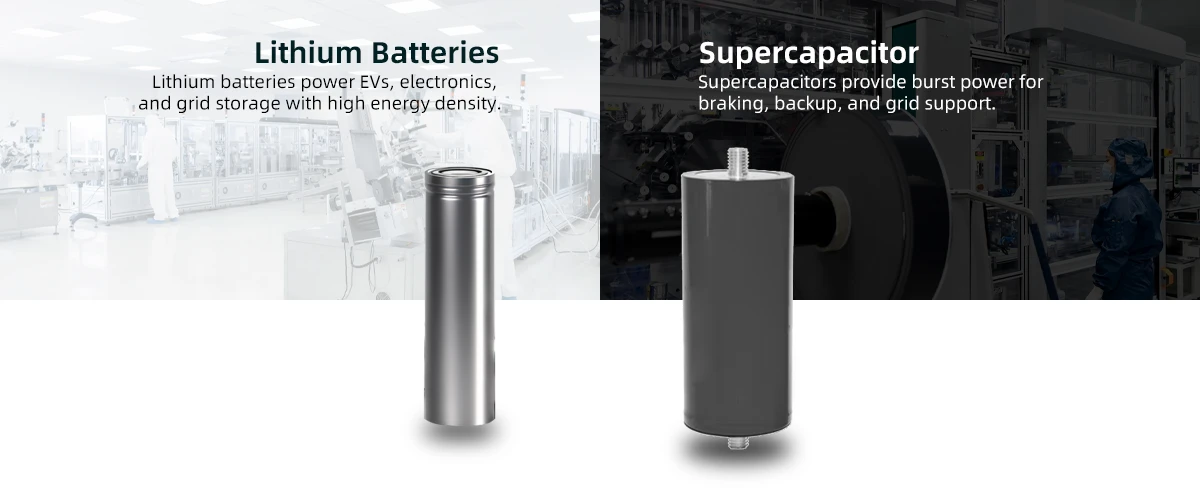
Trois applications industrielles où les systèmes hybrides offrent un retour sur investissement
Le dossier commercial des hybrides supercondensateur-batterie n'est pas théorique. Il se mesure par la réduction des cycles de remplacement des batteries, la diminution des temps d'arrêt du système et le surdimensionnement évité.
1. Régulation de fréquence du réseau et qualité de l'énergie
Les opérateurs de réseau exigent des temps de réponse inférieurs à une seconde pour la régulation primaire de fréquence. Les batteries lithium-ion peuvent fournir cela, mais au prix d'une réduction de leur durée de vie en cycles. Chaque événement de fréquence fait cycler la batterie, consommant sa durée de vie limitée.
Un banc de supercondensateurs placé en parallèle absorbe les pics de puissance à haute fréquence. La batterie assure la fourniture d'énergie soutenue. Résultat : durée de vie en cycles de la batterie prolongée de 3 à 5 fois et coût total de possession réduit de 25 à 40 % sur une durée de vie système de 10 ans.
Résultat système documenté :Une installation de régulation de fréquence de 10 MW remplaçant 100 % de la réponse par batterie par une répartition hybride 80/20 batterie-supercondensateur a rapporté une dégradation de batterie de 0,018 % par cycle au lieu de 0,045 % par cycle. Le remplacement des supercondensateurs n'a pas été nécessaire pendant la période de surveillance de 8 ans.
2. Récupération d'énergie des grues, ascenseurs et machines lourdes
Les opérations de levage génèrent de l'énergie de freinage régénératif. Cette énergie arrive sous forme de rafales de 5 à 15 secondes à 3 à 5 fois la puissance nominale du système. Une batterie dimensionnée pour absorber cette puissance est surdimensionnée par rapport à son besoin énergétique.
Un banc de supercondensateurs capture l'énergie de freinage et la restitue pour le levage suivant. La batterie fournit la puissance de base. La consommation d'énergie diminue de 20 à 35 %. La taille de la batterie diminue de 40 à 60 %.
Pour les équipes d'approvisionnement qui achètent des équipements destinés à l'intégration du stockage d'énergie, cela se traduit par une réduction du coût d'investissement de la batterie et une période d'amortissement plus rapide pour le supercondensateur.
3. Maintien d'alimentation des alimentations sans interruption (UPS)
Les systèmes UPS des centres de données doivent assurer la transition pendant les 10 à 60 secondes entre une panne du réseau et le démarrage du générateur. Les batteries au plomb ont historiquement assuré ce rôle, mais leur cycle de remplacement de 3 à 5 ans et leur sensibilité à la température sont coûteux. Le lithium-ion prolonge la durée de vie en cycles mais se dégrade toujours lors des décharges à fort courant.
Les modules de supercondensateurs fournissent la puissance de maintien sans dégradation. La durée de vie en cycles est effectivement illimitée pour cette application. La maintenance est quasi nulle. Le banc de batteries peut être réduit pour gérer uniquement les coupures prolongées.
Fabrication de cellules de supercondensateurs : exigences en équipements
Le procédé de fabrication des cellules de supercondensateurs présente des similitudes superficielles avec les batteries lithium-ion — revêtement des électrodes, bobinage ou empilage, remplissage d'électrolyte, étanchéification — mais les ensembles de matériaux, les exigences de précision et les points de contrôle qualité sont distincts.
Séquence d'équipements de base pour la production de supercondensateurs EDLC
|
Station |
Spécification clé |
Différence par rapport aux équipements Li-Ion |
|
Machine de revêtement des électrodes |
Bouillie de carbone actif sur feuille d'aluminium ; charge de 5 à 15 mg/cm² |
Nécessite une uniformité d'épaisseur de revêtement plus élevée ; la rhéologie de la bouillie de carbone diffère des bouillies de batterie |
|
Calandrage des électrodes |
Densité compactée de 0,5 à 0,8 g/cm³ |
Objectifs de densité beaucoup plus faibles que pour les électrodes de batterie ; un calandrage excessif écrase la structure poreuse |
|
Machine de bobinage |
Bobinage de supercondensateur cylindrique ; alignement électrode-séparateur ±0,3 mm |
Les largeurs d'électrodes sont généralement de 50 à 150 mm pour les cellules cylindriques ; la manipulation du séparateur est plus critique en raison de sa faible épaisseur |
|
Remplissage d'électrolyte |
Électrolyte à base d'acétonitrile ou de carbonate de propylène ; humidité |
L'électrolyte est plus volatil que celui des Li-Ion ; le remplissage exige un contrôle d'atmosphère plus strict |
|
Scellage et test des cellules |
Test de fuite, mesure de capacité et d'ESR |
La capacité et l'ESR sont les principaux indicateurs de qualité, et non la tension ou la capacité énergétique |
Un fabricant d'équipements de ligne de production de supercondensateurs doit fournir des stations de revêtement capables de traiter des bouillies de carbone actif avec des viscosités allant jusqu'à 5 000 mPa·s et des machines de bobinage avec un contrôle de tension optimisé pour les séparateurs plus fins et plus fragiles utilisés dans les supercondensateurs.
Problème de production documenté :Une ligne de supercondensateurs utilisant une machine de revêtement d'électrodes lithium-ion standard a constaté une variation de capacité de ±12 % entre les cellules. La cause première était une charge de carbone actif incohérente due à la décantation de la bouillie dans le réservoir de la machine de revêtement. La correction a nécessité un système d'alimentation agité conçu pour les bouillies de carbone, et non le système standard de distribution de bouillie de batterie.
Matrice de décision d'approvisionnement : supercondensateur contre batterie
|
Critère de sélection |
Choisir un supercondensateur |
Choisir une batterie lithium-ion |
Solution hybride |
|
Durée de décharge requise |
|
> 5 minutes |
1 seconde à 5 minutes |
|
Durée de vie en cycles requise |
> 100 000 cycles |
|
Cycle de service mixte |
|
Température de fonctionnement |
-40 °C à +70 °C sans réduction de puissance |
-20 °C à +60 °C |
Large plage de température avec un besoin énergétique élevé |
|
Fenêtre de maintenance |
Minimale ; aucun remplacement pendant 10 ans |
Remplacement tous les 3 à 10 ans |
Le supercondensateur gère les cycles à haute fréquence ; la batterie est remplacée moins fréquemment |
|
Sensibilité au coût de l'énergie |
Un coût élevé par kWh est acceptable si la fourniture de puissance est le besoin principal |
Un faible coût par kWh est essentiel |
Coût optimisé en dimensionnant chaque technologie selon son rôle |
Pour les achats industriels, un fournisseur d'équipements d'assemblage de cellules de supercondensateurspeut fournir la capacité de fabrication nécessaire pour produire les cellules de supercondensateurs qui permettent ces architectures hybrides. Pour les intégrateurs système qui s'approvisionnent directement en cellules, il est essentiel de spécifier la tolérance d'ESR et de capacité : des cellules de supercondensateurs avec une variation de capacité >5 % créent des problèmes d'équilibrage dans les chaînes en série.
Point clé de conception du système :L'erreur d'architecture hybride la plus courante est le sous-dimensionnement du banc de supercondensateurs. Les concepteurs de systèmes spécifient souvent les supercondensateurs en fonction du besoin de puissance moyen, et non du besoin maximal. Dans le freinage régénératif ou la régulation de fréquence, la puissance de crête peut être 5 fois supérieure à la moyenne pendant des durées inférieures à 10 secondes. Un banc de supercondensateurs dimensionné pour la puissance moyenne sera entièrement déchargé avant la fin du cycle de récupération d'énergie, obligeant la batterie à absorber le reste — exactement la condition que l'hybride a été conçu pour éviter.
Questions fréquemment posées (FAQ)
Q : Les supercondensateurs peuvent-ils remplacer les batteries lithium-ion dans les véhicules électriques ?
R : Non. Les supercondensateurs ne peuvent pas fournir l'énergie durable nécessaire à l'autonomie d'un véhicule. Ils sont utilisés dans les systèmes hybrides pour la récupération d'énergie du freinage régénératif et l'augmentation de l'accélération, où ils prolongent la durée de vie de la batterie en absorbant les transitoires de forte puissance.
Q : Quelle est la durée de vie typique d'un supercondensateur en utilisation industrielle ?
R : 10 à 15 ans, avec une dégradation minimale s'il fonctionne dans les limites de tension et de température nominales. Les supercondensateurs n'ont pas de limite de durée de vie en cycles comparable aux batteries ; le vieillissement calendaire, et non les cycles, détermine la fin de vie.
Q : En quoi les cellules de supercondensateurs diffèrent-elles des cellules lithium-ion lors de la fabrication ?
R : Les électrodes des supercondensateurs utilisent du charbon actif, et non des oxydes métalliques de lithium. L'électrolyte est généralement à base d'acétonitrile plutôt qu'à base de carbonate. La tolérance à l'humidité est plus stricte (
Q : Pourquoi les supercondensateurs sont-ils plus chers par kWh que les batteries ?
R : Parce que les supercondensateurs stockent l'énergie physiquement (séparation de charges) plutôt que chimiquement. La densité énergétique est intrinsèquement limitée par la surface des électrodes et la tension de claquage de l'électrolyte. Leur proposition de valeur réside dans la fourniture de puissance et la durée de vie en cycles, et non dans le coût du stockage d'énergie.
Prêt à fabriquer des cellules de supercondensateurs ?
Le marché des supercondensateurs s'étend au-delà des applications de niche vers le stockage d'énergie industriel grand public. Pour les fabricants entrant sur ce marché, les équipements de production doivent être spécialement conçus pour les matériaux et les procédés des supercondensateurs — et non adaptés à partir de lignes de batteries avec des compromis.
TOB New Energy fournit des lignes complètes de production de cellules de supercondensateurs, du revêtement des électrodes et du bobinage jusqu'au remplissage d'électrolyte et aux tests, conçues spécifiquement pour les technologies de condensateurs EDLC et hybrides. Les équipements sont fabriqués, assemblés et testés dans une usine source unique à Xiamen, en Chine.Demandez les spécifications des lignes de production de supercondensateurs et les tarifs directs d'usine.
Ce guide technique a été préparé par l'équipe d'ingénierie des procédés de TOB New Energy, un fabricant direct d'équipements de production de batteries lithium-ion et de supercondensateurs basé à Xiamen, en Chine. Les équipements sont conçus et mis en service pour répondre aux exigences de la fabrication industrielle, et non pour des démonstrations en laboratoire.
 abonnez-vous