Chinese
 English
 Deutsch
 italiano
 español
 português
 Nederlands
 日本語
日本語 한국의
한국의




Catégories
Produits chauds
Une avancée majeure dans le domaine des batteries au lithium organique : performances stables de -70 °C à 80 °C
Mar 17,2026Une équipe de recherche dirigée par le professeur Xu Yunhua de l'Université de Tianjin, en collaboration avec l'équipe du professeur Huang Fei de l'Université de technologie de Chine méridionale et d'autres institutions, a mis au point un nouveau type de matériau de cathode organique. Ce matériau lève les obstacles qui limitaient depuis longtemps l'application pratique des batteries lithium-ion organiques traditionnelles, tels que leur faible capacité énergétique et leur lenteur de charge. Les résultats ont été publiés en ligne le 19 février (heure de Pékin) dans la revue scientifique internationale Nature.
Dans le contexte de la révolution technologique et de la transition énergétique, les batteries au lithium sont devenues le cœur énergétique de la société moderne, jouant un rôle de plus en plus vital. Actuellement, la plupart des cathodes de batteries au lithium courantes sont fabriquées à partir de minéraux inorganiques tels que le cobalt et le nickel, qui présentent de multiples inconvénients, notamment la rareté des ressources, leur coût élevé et leur flexibilité limitée. À l'inverse, les matériaux d'électrode organiques offrent des avantages tels que l'abondance des ressources, la flexibilité de conception moléculaire et leur souplesse intrinsèque. Cependant, les batteries utilisant ces matériaux souffrent souvent d'une capacité énergétique insuffisante ou d'une charge lente, ce qui freine considérablement leur commercialisation.
Pour résoudre ce problème, l'équipe de recherche s'est appuyée sur un nouveau matériau polymère conducteur et a optimisé de manière systématique l'efficacité du transport synergique des électrons et des ions lithium au sein de ce matériau. Ceci a permis de développer avec succès un matériau de cathode organique qui combine une excellente conductivité électronique, un transport rapide des ions lithium et une capacité de stockage d'énergie élevée.
Grâce à ce matériau, l'équipe a fabriqué une pile organique de type poche présentant une densité énergétique supérieure à 250 wattheures par kilogramme, surpassant ainsi les batteries lithium-fer-phosphate (LFP) largement utilisées. Cette batterie a démontré une remarquable adaptabilité thermique, fonctionnant de manière stable sur une large plage de températures allant de -70 °C à 80 °C. Elle a également fait preuve d'une bonne flexibilité et d'une sécurité optimale.
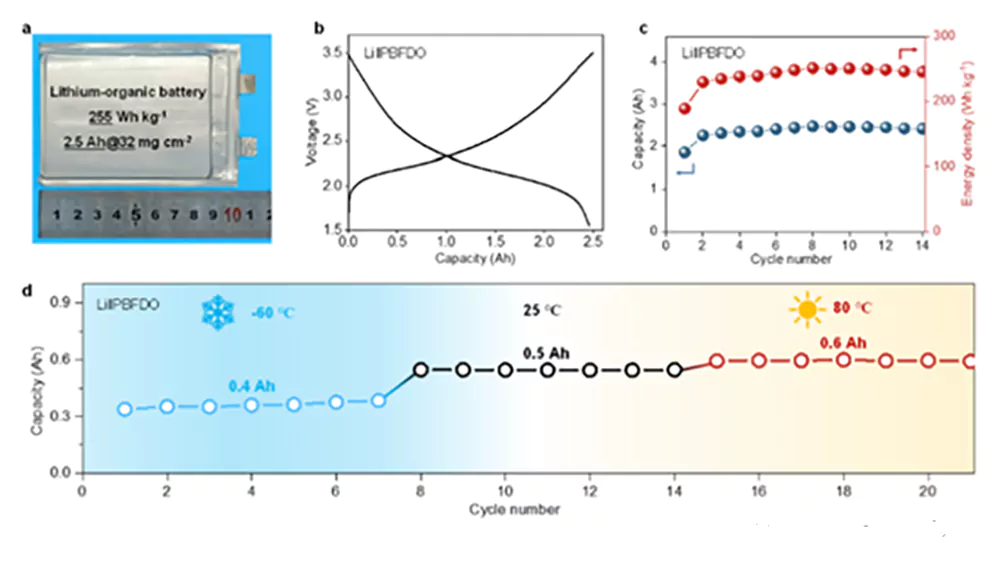
Graphique de performance de la cellule organique en forme de poche. (Image) (Fourni par l'Université de Tianjin)
Les expériences ont démontré que les électrodes restaient intactes malgré les flexions, les étirements et les compressions externes, sans perte de capacité. De plus, la pile à poche a passé avec succès des tests rigoureux de pénétration par clou, confirmant ainsi sa sécurité.
Le professeur Xu Yunhua a souligné que ces avancées constituent une base matérielle essentielle pour le développement futur des « batteries vertes ». Les caractéristiques flexibles du matériau ouvrent également la voie à de nouvelles solutions de stockage d'énergie pour des domaines émergents tels que l'électronique flexible et les dispositifs portables.
D'après les informations disponibles, l'équipe accélère ses efforts pour traduire cette technologie en applications concrètes et favoriser son industrialisation. Elle travaille à la mise en place de lignes de production de cellules organiques en forme de poche et explore activement leur potentiel commercial.
 abonnez-vous